
Part B · Steering and sailing rules · Rule 12
Sailing Vessels
12(a) When two sailing vessels are approaching one another, so as to involve risk of collision, one of them shall keep out of the way of the other as follows:
- “When two sailing vessels are approaching one another, so as to involve risk of collision”Both vessels must be sailing vessels as defined in Rule 3(c): under sail, with any engine not being used. A yacht motor-sailing is a power-driven vessel, so Rule 12 doesn’t apply to her. Use Rule 7 to decide whether risk of collision exists.
- “one of them shall keep out of the way of the other as follows”Sub-paragraphs (i) to (iii) say which one gives way. She takes early and substantial action to keep well clear (Rule 16). The other keeps her course and speed (Rule 17).
Rule 12 decides who gives way between two sailing vessels, using the wind, not their bearing from each other. It doesn’t apply if one is overtaking the other: the overtaking vessel always keeps out of the way (Rule 13(a)).
12(a)(i) When each has the wind on a different side, the vessel which has the wind on the port side shall keep out of the way of the other;
- “When each has the wind on a different side”The vessels are on opposite tacks: one has the wind on her port side (port tack), the other on her starboard side (starboard tack).
- “the vessel which has the wind on the port side shall keep out of the way of the other”The port-tack vessel gives way; the starboard-tack vessel stands on.
Opposite tacks: port tack gives way to starboard tack.
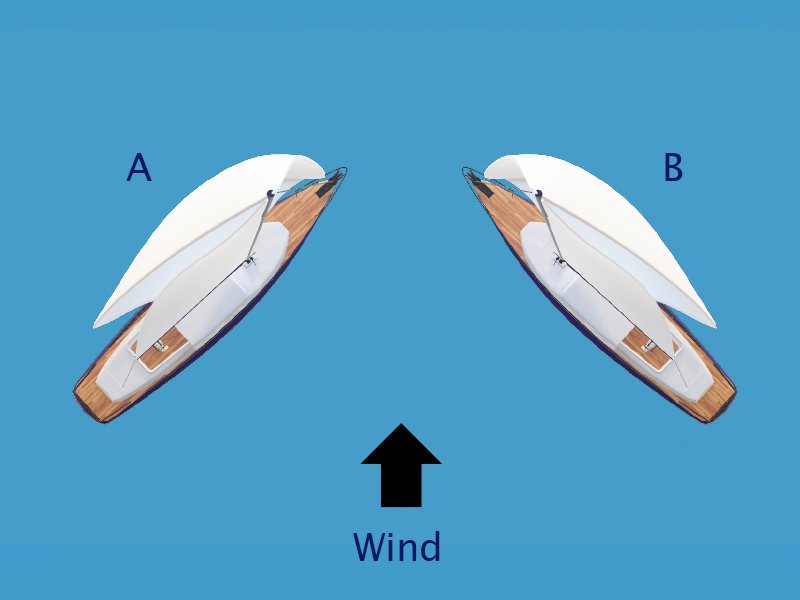
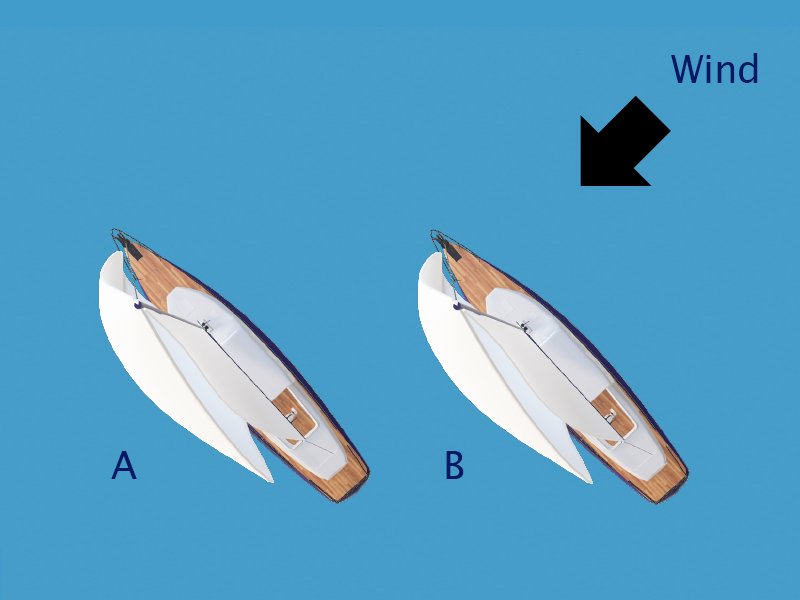
12(a)(ii) When both have the wind on the same side, the vessel which is to windward shall keep out of the way of the vessel which is to leeward;
- “When both have the wind on the same side”Both vessels are on the same tack.
- “the vessel which is to windward shall keep out of the way of the vessel which is to leeward”The windward vessel is the one nearer the wind (upwind); she gives way. The leeward vessel, downwind, stands on.
Same tack: windward gives way to leeward.
12(a)(iii) If a vessel with the wind on the port side sees a vessel to windward and cannot determine with certainty whether the other vessel has the wind on the port or on the starboard side, she shall keep out of the way of the other.
- “If a vessel with the wind on the port side sees a vessel to windward”This applies only to a port-tack vessel, and only when the other sailing vessel is to windward of her.
- “and cannot determine with certainty whether the other vessel has the wind on the port or on the starboard side”She can’t tell which tack the other is on, for example at night, when the other’s sails can’t be seen.
- “she shall keep out of the way of the other”She gives way. If the other is on starboard tack, (i) requires that anyway. If the other is also on port tack, the other is to windward and would give way under (ii), but the port-tack vessel can’t be sure of that, so she keeps clear.
On port tack and unsure of a windward vessel’s tack? Assume you are the give-way vessel and keep clear.
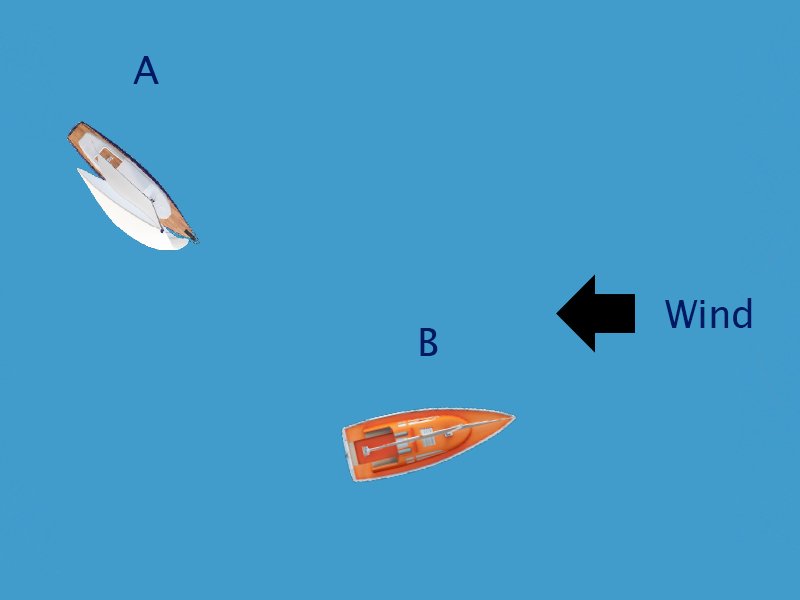
12(b) For the purposes of this Rule the windward side shall be deemed to be the side opposite to that on which the mainsail is carried or, in the case of a square-rigged vessel, the side opposite to that on which the largest fore-and-aft sail is carried.
- “For the purposes of this Rule the windward side shall be deemed to be the side opposite to that on which the mainsail is carried”This decides which side is the windward side, and so which tack a vessel is on. If the mainsail is out to starboard, the windward side is port, so she is on port tack. This settles the question when the wind is right astern.
- “or, in the case of a square-rigged vessel, the side opposite to that on which the largest fore-and-aft sail is carried”For a square-rigged vessel, use her largest fore-and-aft sail instead of the mainsail.
Look at the mainsail: the wind side is the opposite side. Mainsail to starboard means port tack; mainsail to port means starboard tack.