
Part B · Steering and sailing rules · Rule 7
Risk of Collision
7(a) Every vessel shall use all available means appropriate to the prevailing circumstances and conditions to determine if risk of collision exists. If there is any doubt such risk shall be deemed to exist.
- “Every vessel shall use all available means appropriate to the prevailing circumstances and conditions”Use every suitable method you have, such as watching the other vessel, taking compass bearings, radar and AIS. What is appropriate depends on the conditions.
- “to determine if risk of collision exists”The aim is to decide early whether you and another vessel could collide if neither of you changes course or speed.
- “If there is any doubt such risk shall be deemed to exist”If you are not sure, treat it as a risk of collision and act on that basis.
When in doubt, assume risk of collision exists. Acting early on a doubt costs little; waiting for certainty can leave no time to act.
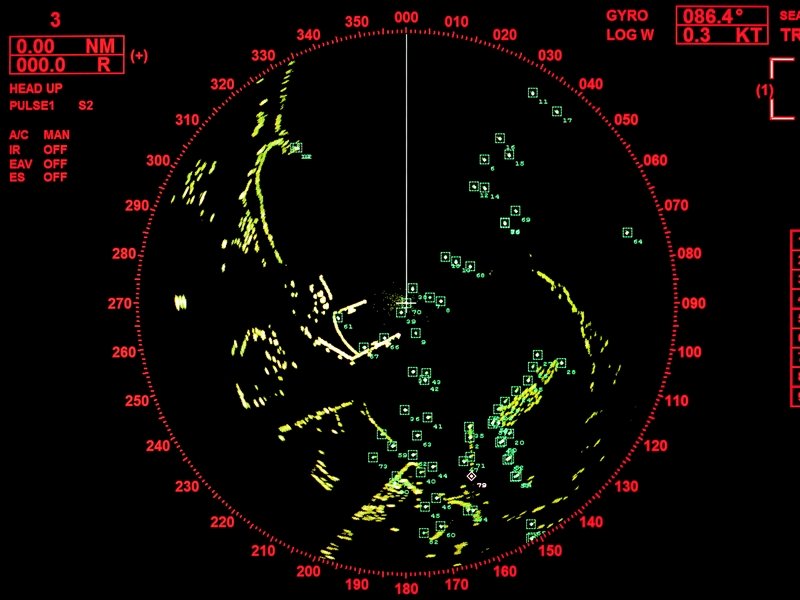


7(b) Proper use shall be made of radar equipment if fitted and operational, including long-range scanning to obtain early warning of risk of collision and radar plotting or equivalent systematic observation of detected objects.
- “Proper use shall be made of radar equipment if fitted and operational”If your vessel has working radar, you must use it properly whenever it can help you judge the risk of collision, not only in poor visibility.
- “including long-range scanning to obtain early warning of risk of collision”Look at longer range scales as well as short ones, so you spot approaching vessels early.
- “and radar plotting or equivalent systematic observation of detected objects”Track each target over time, by plotting or with ARPA, to work out its course, speed and how close it will pass (CPA). A single glance at the screen is not enough.
Radar only gives early warning if it is used properly: scan at long range and track targets systematically.
7(c) Assumptions shall not be made on the basis of scanty information, especially scanty radar information.
- “Assumptions shall not be made on the basis of scanty information, especially scanty radar information”Don’t decide what another vessel is doing from too little information, such as one or two radar observations or a brief sighting. Keep watching until you have enough to be sure.
A radar plot from one or two observations can be misleading. Take more observations before deciding there is no risk.
7(d) In determining if risk of collision exists the following considerations shall be among those taken into account:
- “In determining if risk of collision exists the following considerations shall be among those taken into account”The two points in (i) and (ii) must always be considered, but they are not the only ones.
The compass bearing is the main practical test of risk of collision, but (ii) shows that it has limits.
7(d)(i) Such risk shall be deemed to exist if the compass bearing of an approaching vessel does not appreciably change.
- “Such risk shall be deemed to exist if the compass bearing of an approaching vessel does not appreciably change”Take a series of compass bearings of the other vessel. If she is getting closer and her bearing is not changing noticeably, you are on a collision course.
Steady bearing and closing range mean risk of collision. Use a compass bearing, not a relative bearing: a relative bearing changes whenever your own heading changes.
7(d)(ii) Such risk may sometimes exist even when an appreciable bearing change is evident, particularly when approaching a very large vessel or a tow or when approaching a vessel at close range.
- “Such risk may sometimes exist even when an appreciable bearing change is evident”A changing bearing does not always mean you are safe.
- “particularly when approaching a very large vessel or a tow”A long ship or tow covers a lot of water. The bearing of her bow or bridge may change while her stern, or the vessel she is towing, is still on a collision course with you.
- “or when approaching a vessel at close range”Close in, the bearing changes quickly even when the vessels are going to pass dangerously close.
With large ships, tows and vessels at close range, a changing bearing is not proof of safety. Take bearings of different parts of a long vessel or tow, and keep watching.