
Part B · Steering and sailing rules · Rule 10
Traffic Separation Schemes
10(a) This Rule applies to traffic separation schemes adopted by the Organization and does not relieve any vessel of her obligation under any other Rule.
- “This Rule applies to traffic separation schemes adopted by the Organization”Rule 10 covers traffic separation schemes (TSS) adopted by the International Maritime Organization (IMO), such as the Dover Strait TSS. Schemes set up locally, for example by a harbour authority, may have their own rules (Rule 1(b)).
- “and does not relieve any vessel of her obligation under any other Rule”All the other Rules still apply inside a TSS: look-out, safe speed, risk of collision and the steering and sailing rules. Being in a lane gives a vessel no special right of way.
A TSS organises traffic, but apart from the duties in 10(i) and 10(j) it doesn’t change who gives way. If two vessels in a TSS are crossing or overtaking, Rules 13 to 17 still apply.
10(b) A vessel using a traffic separation scheme shall:
- “A vessel using a traffic separation scheme shall”Every vessel using the scheme must follow (i) to (iii).
Using a TSS means following the lane rules in (i) to (iii).
10(b)(i) Proceed in the appropriate traffic lane in the general direction of traffic flow for that lane;
- “Proceed in the appropriate traffic lane in the general direction of traffic flow for that lane”Use the lane meant for your direction of travel and follow its direction of flow, shown on the chart by arrows.
Keep to the correct lane and go with the flow, like driving on a dual carriageway.
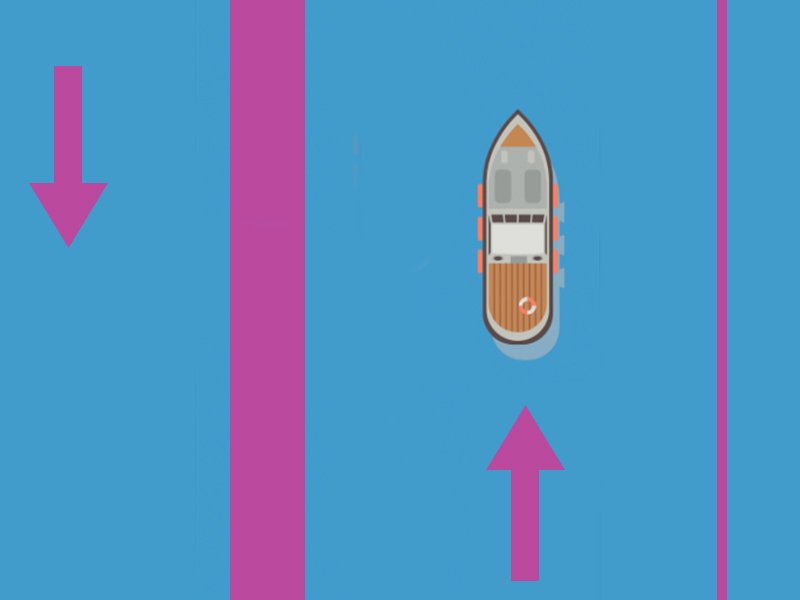
10(b)(ii) So far as practicable keep clear of a traffic separation line or separation zone;
- “So far as practicable keep clear of a traffic separation line or separation zone”The separation zone or line divides the opposing lanes. Keep away from it, so you are not close to traffic going the other way.
Stay well inside your lane, away from the separation zone and the opposing traffic beyond it.
10(b)(iii) Normally join or leave a traffic lane at the termination of the lane, but when joining or leaving from either side shall do so at as small an angle to the general direction of traffic flow as practicable.
- “Normally join or leave a traffic lane at the termination of the lane”The usual place to join or leave a lane is at either end of it.
- “but when joining or leaving from either side shall do so at as small an angle to the general direction of traffic flow as practicable”If you join or leave from the side, merge in or out at a shallow angle, like joining a motorway, so you fit into the traffic stream.
Join and leave at the ends; if you must use the side, do it at a shallow angle. This is the opposite of crossing (10(c)), which is done at right angles.
10(c) A vessel shall so far as practicable avoid crossing traffic lanes but if obliged to do so shall cross on a heading as nearly as practicable at right angles to the general direction of traffic flow.
- “A vessel shall so far as practicable avoid crossing traffic lanes”Cross a scheme only if you need to.
- “but if obliged to do so shall cross on a heading as nearly as practicable at right angles to the general direction of traffic flow”Steer a heading at right angles to the traffic flow. It is your heading that counts, not your track: if a tidal stream sets you along the lane, keep the right-angle heading anyway.
Cross on a heading at right angles to the lane. This gets you across quickly and shows other vessels clearly that you are crossing.
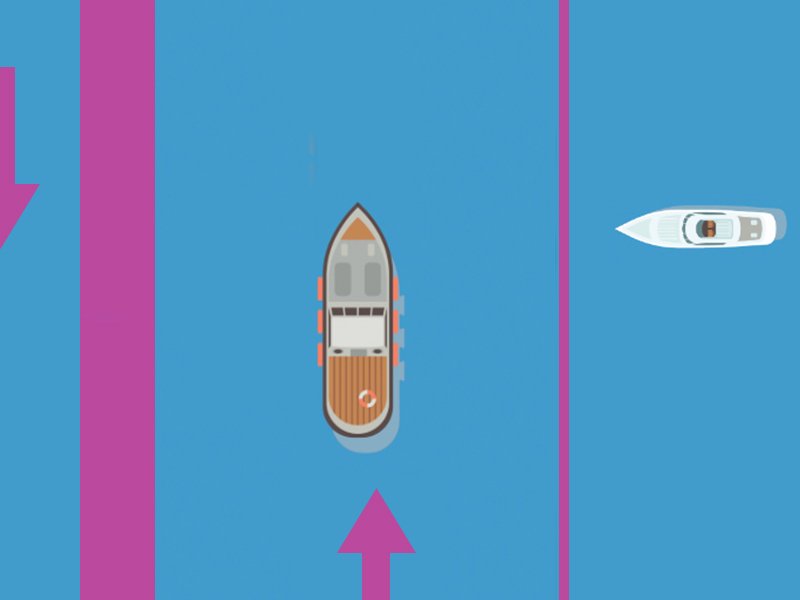

10(d) (i) A vessel shall not use an inshore traffic zone when she can safely use the appropriate traffic lane within the adjacent traffic separation scheme. However, vessels of less than 20 metres in length, sailing vessels and vessels engaged in fishing may use the inshore traffic zone.
- “A vessel shall not use an inshore traffic zone when she can safely use the appropriate traffic lane within the adjacent traffic separation scheme”An inshore traffic zone is the area between the landward edge of a scheme and the coast. A vessel that can safely use the scheme’s lane must use it, not the inshore zone.
- “However, vessels of less than 20 metres in length, sailing vessels and vessels engaged in fishing may use the inshore traffic zone”Vessels under 20 metres, sailing vessels and vessels engaged in fishing are free to use the inshore zone.
Through traffic uses the scheme’s lanes. Vessels under 20 metres, sailing vessels and fishing vessels may use the inshore traffic zone instead.
10(d)(ii) Notwithstanding subparagraph (d)(i), a vessel may use an inshore traffic zone when en route to or from a port, offshore installation or structure, pilot station or any other place situated within the inshore traffic zone, or to avoid immediate danger.
- “Notwithstanding subparagraph (d)(i), a vessel may use an inshore traffic zone when en route to or from a port, offshore installation or structure, pilot station or any other place situated within the inshore traffic zone”Any vessel may use the inshore zone to reach, or come from, somewhere inside it, such as a port or pilot station.
- “or to avoid immediate danger”Any vessel may also use it to avoid immediate danger.
Other vessels may use an inshore traffic zone only to reach a place within it, or to avoid immediate danger.
10(e) A vessel, other than a crossing vessel or a vessel joining or leaving a lane, shall not normally enter a separation zone or cross a separation line except:
(i) in cases of emergency to avoid immediate danger;
(ii) to engage in fishing within a separation zone.
- “A vessel, other than a crossing vessel or a vessel joining or leaving a lane, shall not normally enter a separation zone or cross a separation line”A vessel travelling along the scheme must keep out of the separation zone and must not cross the separation line. Vessels crossing the scheme, or joining or leaving a lane, are not covered by this.
- “(i) in cases of emergency to avoid immediate danger”She may do so in an emergency, to avoid immediate danger.
- “(ii) to engage in fishing within a separation zone”A vessel may also enter a separation zone to fish there.
Stay out of the separation zone unless it is an emergency or you are going there to fish. A vessel fishing in the zone must still not impede vessels following a lane (10(i)).
10(f) A vessel navigating in areas near the terminations of traffic separation schemes shall do so with particular caution.
- “A vessel navigating in areas near the terminations of traffic separation schemes shall do so with particular caution”At either end of a scheme, vessels are joining, leaving and changing course, and traffic from several directions meets. Keep a sharp look-out and be ready to act early.
Take extra care at the ends of a TSS, where traffic converges and changes direction.
10(g) A vessel shall so far as practicable avoid anchoring in a traffic separation scheme or in areas near its terminations.
- “A vessel shall so far as practicable avoid anchoring in a traffic separation scheme or in areas near its terminations”Don’t anchor in a scheme or near its ends unless you have no practical choice. An anchored vessel there is an obstacle in a busy traffic stream.
Anchor clear of traffic separation schemes and their ends.
10(h) A vessel not using a traffic separation scheme shall avoid it by as wide a margin as is practicable.
- “A vessel not using a traffic separation scheme shall avoid it by as wide a margin as is practicable”If you are not using the scheme, keep well away from it rather than skirting its edge.
Either use a TSS properly or keep well clear of it.
10(i) A vessel engaged in fishing shall not impede the passage of any vessel following a traffic lane.
- “A vessel engaged in fishing shall not impede the passage of any vessel following a traffic lane”A vessel fishing with gear that restricts her manoeuvrability (Rule 3(d)) must not get in the way of any vessel following a lane, and should act early to avoid doing so (Rule 8(f)).
Fishing in or near a TSS is allowed, but not in a way that obstructs vessels following the lanes.
10(j) A vessel of less than 20 metres in length or a sailing vessel shall not impede the safe passage of a power-driven vessel following a traffic lane.
- “A vessel of less than 20 metres in length or a sailing vessel”Any vessel under 20 metres, power or sail, and sailing vessels of any size.
- “shall not impede the safe passage of a power-driven vessel following a traffic lane”Keep out of the way of power-driven vessels following a lane, and act early so they don’t have to alter course or speed for you (Rule 8(f)).
Small craft and sailing vessels must keep clear of power-driven vessels in the lanes. As in narrow channels, Rule 18 begins “Except where Rules 9, 10 and 13 otherwise require”, so the usual order between power and sail doesn’t apply here.
10(k) A vessel restricted in her ability to manoeuvre when engaged in an operation for the maintenance of safety of navigation in a traffic separation scheme is exempted from complying with this Rule to the extent necessary to carry out the operation.
- “A vessel restricted in her ability to manoeuvre when engaged in an operation for the maintenance of safety of navigation in a traffic separation scheme”For example, a vessel servicing buoys or surveying to keep the scheme safe. She shows the RAM signals in Rule 27(b).
- “is exempted from complying with this Rule to the extent necessary to carry out the operation”She may depart from Rule 10, for example by working across the lanes, but only as far as the work requires. All the other Rules still apply.
A RAM vessel maintaining the scheme may depart from Rule 10 only as far as her work needs. Expect to see her working across or against the traffic flow, and keep clear of her (Rule 18).
10(l) A vessel restricted in her ability to manoeuvre when engaged in an operation for the laying, servicing or picking up of a submarine cable, within a traffic separation scheme, is exempted from complying with this Rule to the extent necessary to carry out the operation.
- “A vessel restricted in her ability to manoeuvre when engaged in an operation for the laying, servicing or picking up of a submarine cable, within a traffic separation scheme”A cable ship laying, repairing or recovering a submarine cable in the scheme, showing the RAM signals in Rule 27(b).
- “is exempted from complying with this Rule to the extent necessary to carry out the operation”As in 10(k), she may depart from Rule 10 only as far as the work requires, and all the other Rules still apply.
A cable ship working in a TSS may not follow the lanes. Recognise her by her RAM signals and keep clear.