
Part D · Sound and light signals · Rule 35
Sound signals in restricted visibility
35 In or near an area of restricted visibility, whether by day or night, the signals prescribed in this Rule shall be used as follows:
- “In or near an area of restricted visibility”Restricted visibility is any condition in which visibility is restricted by fog, mist, falling snow, heavy rainstorms, sandstorms or similar causes (Rule 3(l)). “Near” matters: a vessel in clear weather close to a fog bank sounds the signals too, because vessels inside it can’t see her.
- “whether by day or night”Day or night alike.
- “the signals prescribed in this Rule shall be used as follows”The signals are required (“shall”). Which one a vessel sounds depends on what she is and what she is doing, as set out in (a) to (k). They are sounded whether or not any other vessel is known to be nearby.
Fog signals are required in or near restricted visibility, day or night. Each signal tells you what kind of vessel is out there and what she is doing.
35(a) A power-driven vessel making way through the water shall sound at intervals of not more than 2 minutes one prolonged blast.
- “A power-driven vessel making way through the water”A power-driven vessel moving through the water.
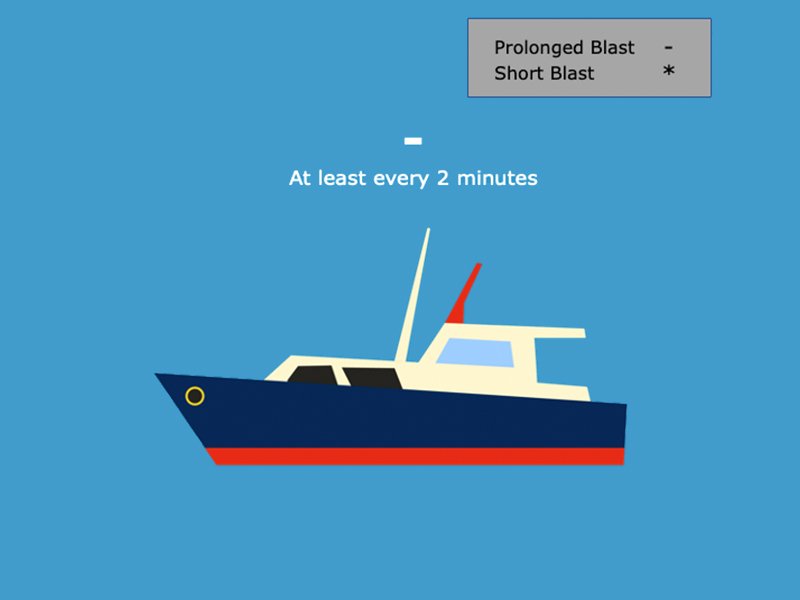
- “shall sound at intervals of not more than 2 minutes one prolonged blast”One prolonged blast (4 to 6 seconds, Rule 32(c)) at least every 2 minutes.
One prolonged blast every 2 minutes or less: power-driven vessel making way.
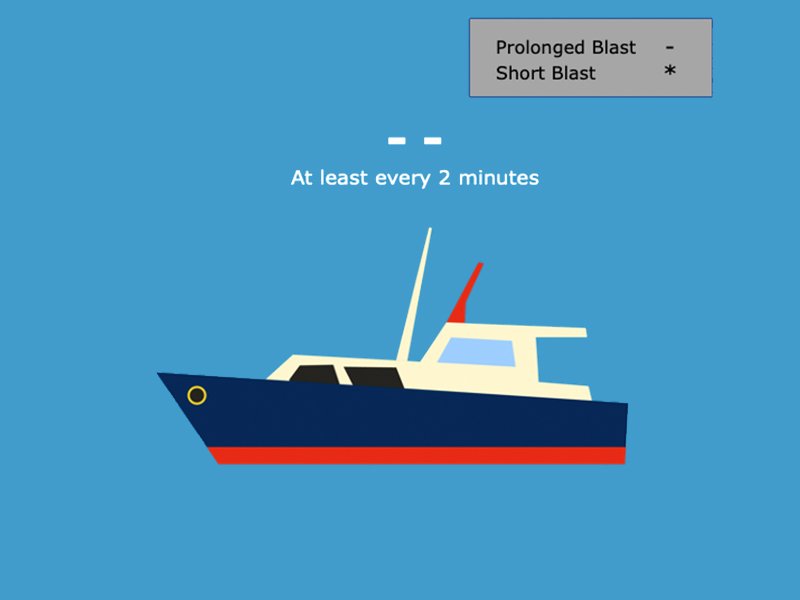
35(b) A power-driven vessel underway but stopped and making no way through the water shall sound at intervals of not more than 2 minutes two prolonged blasts in succession with an interval of about 2 seconds between them.
- “A power-driven vessel underway but stopped and making no way through the water”Underway (not at anchor, made fast or aground) but not moving through the water, for example stopped with engines off.
- “shall sound at intervals of not more than 2 minutes two prolonged blasts in succession with an interval of about 2 seconds between them”Two prolonged blasts about 2 seconds apart, at least every 2 minutes. It tells others she is stopped in the water.
Two prolonged blasts: power-driven vessel underway but stopped.
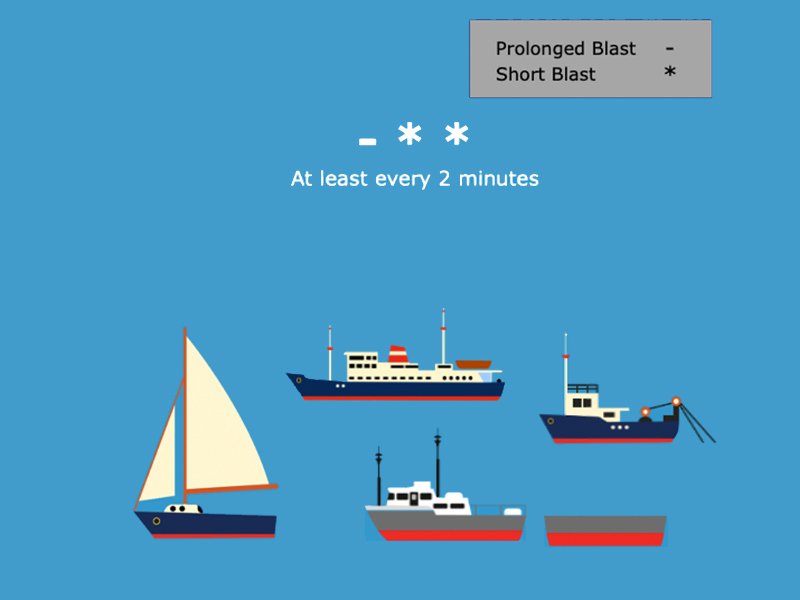
35(c) A vessel not under command, a vessel restricted in her ability to manoeuvre, a vessel constrained by her draught, a sailing vessel, a vessel engaged in fishing and a vessel engaged in towing or pushing another vessel shall, instead of the signals prescribed in paragraphs (a) or (b) of this Rule, sound at intervals of not more than 2 minutes three blasts in succession, namely one prolonged followed by two short blasts.
- “A vessel not under command, a vessel restricted in her ability to manoeuvre, a vessel constrained by her draught, a sailing vessel, a vessel engaged in fishing and a vessel engaged in towing or pushing another vessel”The vessels that can’t easily manoeuvre or that others must keep clear of: NUC, RAM, CBD, sailing, fishing, and towing or pushing (when not a rigid composite unit, 35(f)).
- “shall, instead of the signals prescribed in paragraphs (a) or (b) of this Rule, sound at intervals of not more than 2 minutes three blasts in succession, namely one prolonged followed by two short blasts”One prolonged and two short blasts at least every 2 minutes, instead of the power-driven signals, whether she is making way or not.
One prolonged, two short: one of these vessels, and you can’t tell which from the signal alone. In restricted visibility the Rule 18 duties don’t apply between vessels not in sight of one another; Rule 19 does.
35(d) A vessel engaged in fishing, when at anchor, and a vessel restricted in her ability to manoeuvre when carrying out her work at anchor, shall instead of the signals prescribed in paragraph (g) of this Rule sound the signal prescribed in paragraph (c) of this Rule.
- “A vessel engaged in fishing, when at anchor, and a vessel restricted in her ability to manoeuvre when carrying out her work at anchor”A fishing vessel at anchor, and a RAM vessel working at anchor, for example a dredger or a vessel supporting divers.
- “shall instead of the signals prescribed in paragraph (g) of this Rule sound the signal prescribed in paragraph (c) of this Rule”They sound one prolonged and two short blasts, not the anchor bell. Her signal therefore sounds the same as when she is underway.
Fishing at anchor, or RAM working at anchor: one prolonged, two short, not the bell.
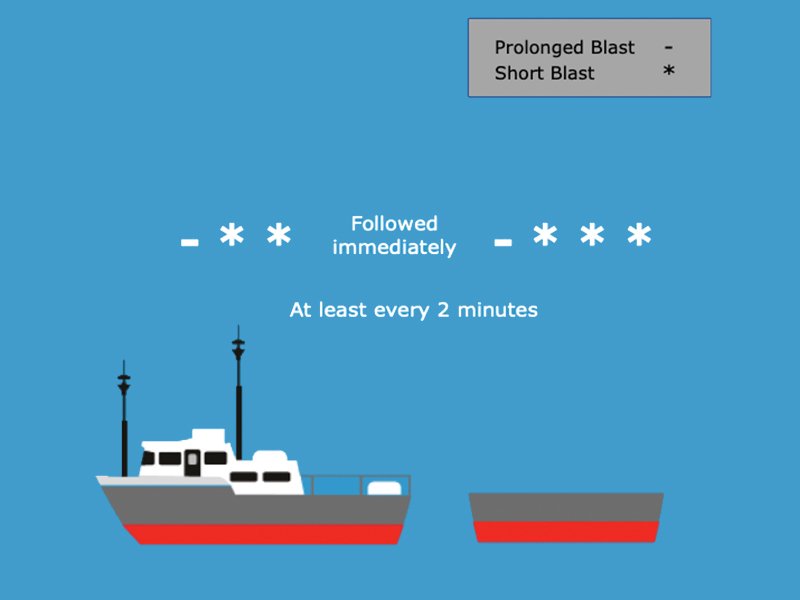
35(e) A vessel towed or if more than one vessel is towed the last vessel of the tow, if manned, shall at intervals of not more than 2 minutes sound four blasts in succession, namely one prolonged followed by three short blasts. When practicable, this signal shall be made immediately after the signal made by the towing vessel.
- “A vessel towed or if more than one vessel is towed the last vessel of the tow, if manned”The vessel being towed, or the last one if there are several, but only if there is someone on board.
- “shall at intervals of not more than 2 minutes sound four blasts in succession, namely one prolonged followed by three short blasts”One prolonged and three short blasts, at least every 2 minutes.
- “When practicable, this signal shall be made immediately after the signal made by the towing vessel”Where possible, straight after the towing vessel’s one prolonged and two short. Heard together, the two signals tell you there is a tow and that someone is on board the towed vessel.
Towing vessel: one prolonged, two short. Manned towed vessel straight after: one prolonged, three short.
35(f) When a pushing vessel and a vessel being pushed ahead are rigidly connected in a composite unit they shall be regarded as a power-driven vessel and shall give the signals prescribed in paragraphs (a) or (b) of this Rule.
- “When a pushing vessel and a vessel being pushed ahead are rigidly connected in a composite unit they shall be regarded as a power-driven vessel”A pusher locked rigidly into a barge counts as one power-driven vessel (as in Rule 24(b)).
- “and shall give the signals prescribed in paragraphs (a) or (b) of this Rule”One prolonged blast when making way; two prolonged blasts when stopped.
Rigid composite unit: power-driven signals, not the towing and pushing signal.
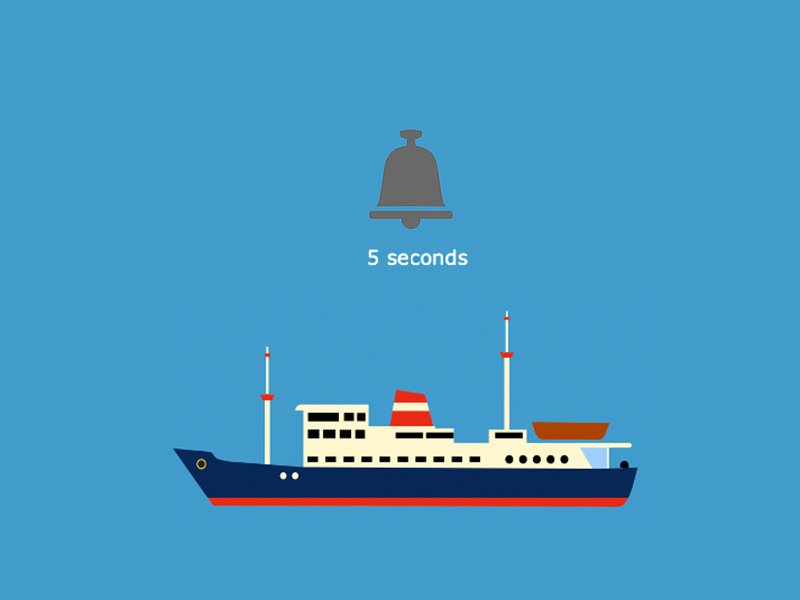
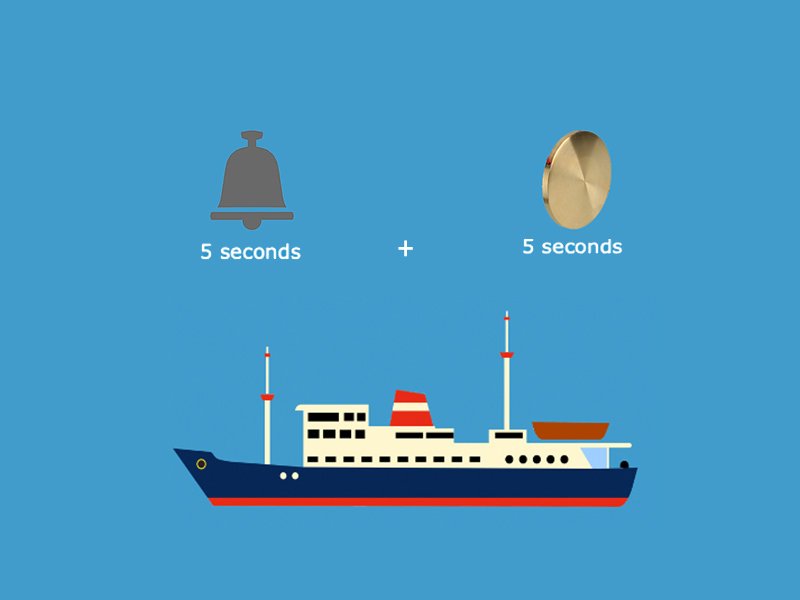
35(g) A vessel at anchor shall at intervals of not more than one minute ring the bell rapidly for about 5 seconds. In a vessel of 100 metres or more in length the bell shall be sounded in the forepart of the vessel and immediately after the ringing of the bell the gong shall be sounded rapidly for about 5 seconds in the after part of the vessel. A vessel at anchor may in addition sound three blasts in succession, namely one short, one prolonged and one short blast, to give warning of her position and of the possibility of collision to an approaching vessel.
- “A vessel at anchor shall at intervals of not more than one minute ring the bell rapidly for about 5 seconds”Rapid ringing of the bell for about 5 seconds, at least once a minute.
- “In a vessel of 100 metres or more in length the bell shall be sounded in the forepart of the vessel and immediately after the ringing of the bell the gong shall be sounded rapidly for about 5 seconds in the after part of the vessel”At 100 metres or more: the bell forward, then straight away the gong aft. Hearing bell then gong tells you she is at least 100 metres long and at anchor.
- “A vessel at anchor may in addition sound three blasts in succession, namely one short, one prolonged and one short blast, to give warning of her position and of the possibility of collision to an approaching vessel”She may also sound short, prolonged, short to warn an approaching vessel that she is there and that there is a risk of collision. This is optional.
At anchor: rapid bell every minute or less; 100 m or more adds the gong aft. Optional warning: short, prolonged, short.
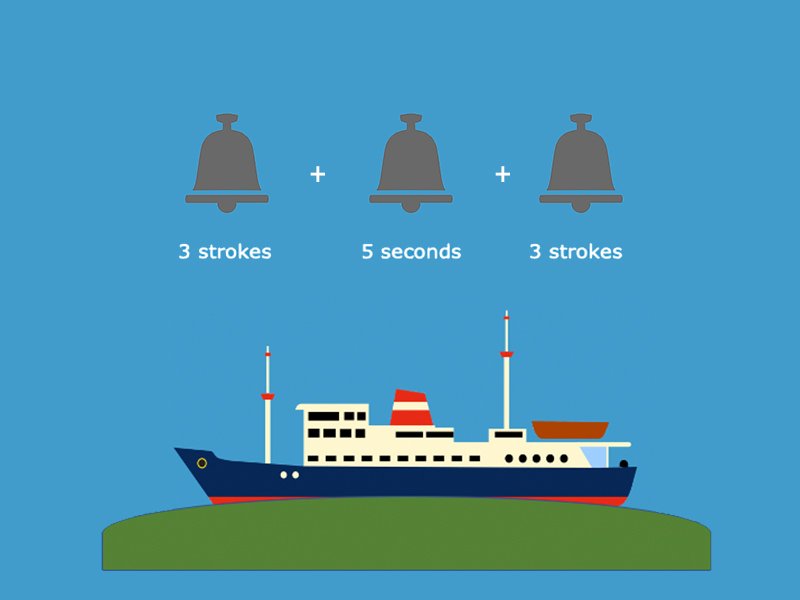
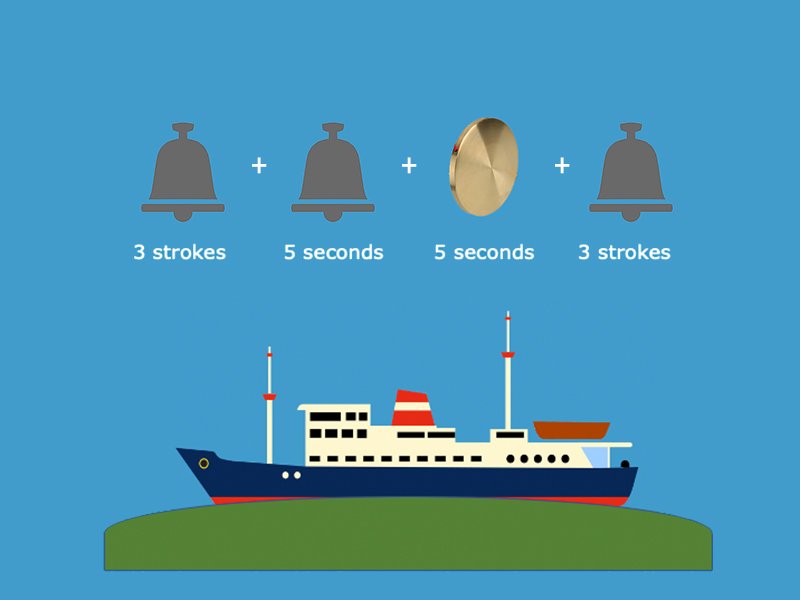
35(h) A vessel aground shall give the bell signal and if required the gong signal prescribed in paragraph (g) of this Rule and shall, in addition, give three separate and distinct strokes on the bell immediately before and after the rapid ringing of the bell. A vessel aground may in addition sound an appropriate whistle signal.
- “A vessel aground shall give the bell signal and if required the gong signal prescribed in paragraph (g) of this Rule”A vessel aground gives the anchor signals: the rapid bell, plus the gong if she is 100 metres or more.
- “and shall, in addition, give three separate and distinct strokes on the bell immediately before and after the rapid ringing of the bell”She adds three separate strokes of the bell just before and just after the rapid ringing: 3 strokes, rapid ringing, 3 strokes (then the gong, if she has one).
- “A vessel aground may in addition sound an appropriate whistle signal”She may also sound a suitable whistle signal to warn approaching vessels. This is optional.
Aground: 3 strokes, rapid bell, 3 strokes (plus gong at 100 m or more).
35(i) A vessel of 12 metres or more but less than 20 metres in length shall not be obliged to give the bell signals prescribed in paragraphs (g) and (h) of this Rule. However, if she does not, she shall make some other efficient sound signal at intervals of not more than 2 minutes.
- “A vessel of 12 metres or more but less than 20 metres in length shall not be obliged to give the bell signals prescribed in paragraphs (g) and (h) of this Rule”From 12 metres up to 20 metres, the bell signals for anchored and aground vessels aren’t required. Vessels of this size needn’t carry a bell (Rule 33(a)).
- “However, if she does not, she shall make some other efficient sound signal at intervals of not more than 2 minutes”If she doesn’t ring a bell, she must make some other efficient sound signal at least every 2 minutes. She still gives the whistle signals in (a) to (f) when underway.
12 m to under 20 m, at anchor or aground: bell optional, but another efficient sound signal at least every 2 minutes.
35(j) A vessel of less than 12 metres in length shall not be obliged to give the above-mentioned signals but, if she does not, shall make some other efficient sound signal at intervals of not more than 2 minutes.
- “A vessel of less than 12 metres in length shall not be obliged to give the above-mentioned signals”Under 12 metres, none of the Rule 35 signals is required.
- “but, if she does not, shall make some other efficient sound signal at intervals of not more than 2 minutes”If she doesn’t give them, she must still make some other efficient sound signal, for example with a handheld horn, at least every 2 minutes.
Under 12 m: Rule 35 signals optional, but some efficient sound signal at least every 2 minutes.
35(k) A pilot vessel when engaged on pilotage duty may in addition to the signals prescribed in paragraphs (a),(b) or (g) of this Rule sound an identity signal consisting of four short blasts.
- “A pilot vessel when engaged on pilotage duty may in addition to the signals prescribed in paragraphs (a),(b) or (g) of this Rule”A pilot vessel on duty first sounds her normal signal: one prolonged making way, two prolonged stopped, or the bell at anchor.
- “sound an identity signal consisting of four short blasts”She may then add four short blasts to show she is a pilot vessel. This is optional.
Normal fog signal followed by four short blasts: pilot vessel on duty.